Showing posts with label List 13. Show all posts

Thursday, May 9, 2013

The Television Musical: High School Musical and Buffy's "Once More with Feeling"

High School Musical was filmed in Salt Lake City and first premiered on Disney Channel 2006, and has gone on to influence teens and annoy adults all over the world, all while giving Utah residents something to brag about.  The film was directed by Kenny Ortega, whose filmography includes choreographer credits on Dirty Dancing, Ferris Bueller's Day Off, and Newsies. Ortega also directed Newsies, Hocus Pocus, and the HSM sequels, pretty much cementing his place as a Mormon Culture Icon for all eternity.

Joss Whedon has been a legend of Geek Culture since the premier of Buffy the Vampire Slayer in 1997, and has written or co-written many well-known films, such as Toy Story and Atlantis: The Lost Empire.  Despite holding cult status for many years due to fan-loved and critically acclaimed TV series such as Buffy, Angel, and Firefly, as well as a critically loved film Serenity, Josh Whedon has only recently become a household name with the success of Marvel's The Avengers, which he wrote and directed. 

"Once More with Feeling" was a project that Whedon had wanted to attempt since the very beginning of Buffy; however the sheer scope of the project, as well as Whedon's limited free time, kept him from pursuing it. When musician James Marsters joined the cast, Marsters began to encourage Joss to develop his musical abilities.  Around the same time, Whedon invited the cast members of Buffy to a Shakespeare reading at his home, which evolved into a sing-along party.  Impressed by the talent of his cast, Joss finally relented and began work on the episode, which included writing every song in the episode, and even learning how to play the guitar.

Of Joss Whedon, Buffy cast member James Marsters (Spike) said, "Some of Joss's music is surprisingly complicated. Maybe it's a Beatles thing. He doesn't know enough to know what he can't do and he's smashing rules." 

"Once More With Feeling" is included in every "top ten" list for Buffy ever written, was critically acclaimed, and has gained a cult following.  The episode is often mentioned in discussions of the best television episodes ever made.  Whedon has since followed up "Once More" with Dr. Horrible's Sing Along Blog, and a single episode of Glee, which he directed.

MIKE SAYS High School Musical was released around my first year in college at BYU-I and by the time it finally hit DVD, I was sick and tired of hearing about it.  When I finally did see it, I was surprised.  I found the music fairly tolerable, and the moral hit a very personal note . . . mostly because cliques were something I was dealing with everyday . . . well, sort of.  BYU is one big clique, and I seemed to be the only guy who didn't want to be a part of it.

The odd thing to me is that despite the fact that the movie had become the toast of campus, not a single person seemed to take the moral to heart. It helped that the movie was better than I expected.  It is somewhat clever, and despite its cable channel roots, fairly well made.

I will admit, with a small amount of shame, that HSM still gets played from time to time in my house, though to be honest it's usually to sooth a crying baby. Despite my shame, I actually enjoy the film quite a bit.  If there's anything that really ruins the films for me, it's the sequels.  While the first film is fairly fun and original, the following films are superfluous and needless. They highlight the worst parts about the film, such as the video-esque music numbers, with even weaker plots and teeny-bopper drama off the scale.

"Once More with Feeling," however, is not only great, but it stays great, with Joss's follow-up work only highlighting what was so brilliant about the episode in the first place.  "Once More" is perhaps the best, if not the only good thing to come from the very dark Season 6 of Buffy. With death, betrayal, disturbing sexual relationships, and generally depressing themes, Season 6 is probably best avoided for any but the most loyal of fans.

Despite the depressing nature of the season, "Once More" is a triumph.  Not only does it summarize the season and the character relationships in a way even a casual viewer can understand, despite the massive shift in genre and style, the episode stays true to the tone and voice of the series, keeping its wit and style, even through the musical numbers.

The production value of the episode strays some from the usual Buffy episode with different lighting and shots, all in an effort to give the episode the feel of scope and grandeur that is characteristic of a musical but hard to achieve on a TV budget.

The music is startlingly well-written and performed, especially when considering that these numbers are the first songs ever written by Whedon. That the music serves an actual function to the episode and plot is just icing on the cake.  I've often found myself contemplating universal rules of a musical, and it's pure delight that the episode actually tackles this very question on some levels.

As a fan of humor that breaks the fourth wall, the episode is immensely enjoyable for me. Between Anya and Xander's song (sung directly to the audience), Anya's descriptions of the music and its pop culture appeal, and Spike rolling his eyes when he realizes he's singing, this episode had me on the floor laughing.

The emotional power of the third act is far beyond anything a viewer might expect, with solos that are impressive in their execution.  From Giles and Tara's duet to the group number "Walk through the Fire," the music delivers on genuine character moments and development.

The episode also brings back some fairly fond memories for me. The episode premiered not too long before I started working at a Comic Shop, and as lovers of pop culture, we that hung out there would often quote our favorites shows with the faintest excuse. I should probably be more embarrassed to admit that a shop full of guys would often start enthusiastically singing "I've Got a Theory" whenever a question (of any type or level of importance) was posed in the shop. Good times.

And that, sadly, ends our musical list . . . though I think the musical trend may continue in my shower for some time.

KATE SAYS High School Musical is nothing like what I imagined.

For one thing, I didn't realize it was a Disney Channel production. I thought it was a spoof movie, kind of like Scary Movie or the talent show on Buffy, Season 2.

After all, the big cult movie of my youth was Heathers. Are kids nicer now than then? Or more naive?

Because High School Musical is completely and non-satirically cute. Cute from Vanessa Hudgen's brilliant smile to Oleysa Rubin in her bowler hat to the guy who likes to bake. And I can totally see why Zac Efron made such a splash. He is one of the better actors in the musical, for one thing, and he has that je ne sais quoi of potential stardom.(In fact, his wryness keeps the movie from being too unbearably cute, which state-of-being it constantly heads towards for all 98 minutes.)

The music is entirely forgettable.

Disney Channel movies all seem to have the same music--and it is all entirely forgettable. Basically, the music is American Idol meets Teen Pop Star. I wasn't a big fan of Teen Pop when I was a teen. I'm even less of one now.

But the story is, well, cute. And it hangs together. I was genuinely surprised by the "solution" (I thought it would be sillier). And I liked the message even if I found it entirely implausible (I know zero teens who behave like this; Veronica in Heathers--who saves her classmates even though she doesn't especially like them--still makes more sense to me.)

However, although the all-for-one-and-one-for-all payoff of High School Musical would never happen in real life, I think teenagers want it to be possible. It seems like high school will never end when you are in it, so a hopeful future in which everyone gets along is the teen/pack-animal answer to Whedon's question, "Where do we go from here?"

Before I discuss "Once More With Feeling" (without criticism!), I have to remark that watching it reminded me why I despise Season 6 of Buffy and have rarely watched any of the episodes since. Talk about convoluted soap opera story lines--oh, blech. (Not to mention the complete misuse of Spike's potential.)

Still.

"Once More With Feeling" is simply astounding. I hadn't watched it for over 10 years, and it all came rushing back (when it came out, I saw it numerous times).

It is a real tour de force and an excellent place to wind up our list. Whedon creates original, memorable music while at the same time paying tribute to and spoofing the entire genre. The pieces tend more towards light rock than anything else ("Bunnies" being a notable exception). But all the pieces together become a showcase of where musicals have been and, perhaps, will go from Tara and Willow's Mary Poppins' number (in Renaissance dress) to Spike's Rent moment (only his song is better written than the songs from Rent).

The standouts, talent-wise, are Head, Marsters, and Benson, and I noted that they got the most difficult numbers; in fact, James Marsters numbers are downright complicated. I don't know the proper musical terms, but I think he changes keys several times (deliberately; the music calls for it) and has to sing non-harmonious notes. Benson knocks it out of the park (ha ha) with "I'm Under Your Spell." The number I like best--"Standing" which morphs into a refrain of "I'm Under Your Spell" with Benson and Head in duet-- is beautiful and powerful.

Even more impressive is that the music matches the characters. Sarah Michelle Gellar isn't a powerhouse singer by any means, but she fills the role of musical's heroine, mostly due to Whedon's music. The haunting cords of "Going Through the Motions" and "Something to Sing About" are exactly right for Buffy.

From the point of view of this list, what makes this episode ultimately so impressive is that Whedon captures the essence of THE MUSICAL: how it can communicate emotions that can't be communicated otherwise (Across the Universe); how it can showcase talent in a unique way (Funny Girl); how it can push people out of their comfort zones (Rocky Horror); how it can summarize vast amounts of information (Evita); how it can create magic (Chitty, Chitty); how it can just make you feel GREAT (Sound of Music; Singing in the Rain) how it can bring people together (Muppets); how it can pay tribute to other artists and stories (Moulin Rouge; Into the Woods); how it can also go on far too long (all of them).

Sing! Sing! Sing!

But don't forget to stop.

Wednesday, May 1, 2013

Sondheim: A Funny Thing Happened on the Way to the Forum and Into the Woods

Stephen Sondheim is possibly best known for Sweeney Todd for which he wrote both the music and the lyrics. Sweeney Todd and Into the Woods are strictly Sondheim productions--that is, the music and lyrics are the show. He has also contributed music and lyrics to various enterprises, including A Funny Thing Happened on the Way to the Forum.

KATE SAYS A Funny Thing Happened on the Way to the Forum is the silliest movie I've ever seen.

I'm not a huge fan of slapstick, which AFTHOTWTHF contains much of, so I can't say that I fell over laughing while watching it. In fact, I can't say I really knew how to respond to it at all (although the line, "If you never learn, you'll be a eunuch all your life" did provoke belly-chortles). I felt kind of the way I do about The Drew Carey Show. I like Drew Carey--I really enjoy Whose Line Is It Anyway? But I don't get his comedy series. It's like the part of my brain that would find it funny isn't tuned up or something.

Into the Woods poster.jpgDespite being entirely bewildered by A Funny Thing Happened on the Way to the Forum, I did finish it with a greater understanding of musicals and American culture--one, I finally put together the Michael Crawford of Phantom and the Michael Crawford of Hello, Dolly! (He did A Funny Thing in 1966 and Hello, Dolly! in 1969.)

Two, I got a better understand of American comedians in the mid-twentieth century. My exposure to stand-up comedians, in order, has been Bill Cosby; Stephen Wright; Tim Allen; Seinfeld; and Foxworthy. Not quite the same as Forum's Mostel, Gilford, Silvers, and Keaton. (Stand-up comedians as a subculture is another closed book to me--my experience has been fairly limited although I would like to go on record as having been a fan of Cosby's early stand-up before he did The Cosby Show. His routines about growing up in Philly are some of the funniest I've ever heard.)

And of course, there's the recent spoof A Funny Thing Happened on the Way to Thor's Hammer.

Still, the movie was nothing like what I imagined, mostly because I came to Sondheim by way of Dame Judi Dench singing the heartbreaking "Send in the Clowns" and the dark comedy Into the Woods.

I initially saw Into the Woods performed by an off-Broadway traveling company on Halloween Night at BYU a number of years ago. It was the best theatrical evening I've ever had. The performers were full of energy (quite often, Broadway productions can come across as rather "eh"--I saw Les Mis in London, and the only actor acting his heart out was the understudy for Marius); the audience was fully engaged and appreciative plus the auditorium was packed!! Consequently, although I get a big kick out of Bernadette Peters--and I own the live Broadway VHS version of the musical--I still consider the production I saw at BYU the best production ever.

Into the Woods has hilarious parts--my favorite is "Agony" by the Prince Brothers--but it is also rather dark, specifically the second act. This is not to say that it is tragic: if anyone wanted to sell the idea that life is played once as comedy and once as tragedy, Sondheim would that guy. One major theme of Into the Woods is that life is just . . . life. People make mistakes. Witches can be right. Giants can be good. Welcome to the world. 

To me, Into the Woods is the perfect example of the power of fairy-tales (I show parts of it in my folklore class). I may not agree with all Sondheim's interpretations, but he is the ultimate re-imaginer of Cinderella, Jack in the Beanstalk, Little Red Riding hood, etc. He mixes up Freud, Jung, and himself to get an entirely unique and modern look at the grown-up lessons buried in Grimm. He makes you wonder why fairytales ever ended up in the nursery to begin with. Because, truly, they belong on the stage.

MIKE SAYS finding these two movies was a bit of a challenge, though with the combined might of the Internet, Amazon, and my credit card, I was able to finally get ahold of them.  Finding time to watch them was something else entirely!

Into the Woods is a imaginative, clever, and often disturbing mish mash of fairy tales that are made to work together in a pretty clever manner, though not without a price-- at 3 hours, the play might have benefitted from a story or two being left out.

The greatest mercy of the play is that the main events in each of the characters lives are not retold or shown. They live through their well-known adventures and then return to the stage.  The story that binds them together feels fairly authentic, and works well in the context.  As such, I shouldn't have been surprised when it, and most of the other stories, head toward tragedy before winding up.

The music of the play is well done, but not particularly memorable for me.  I'm not sure if it was the production or the numbers themselves, but they didn't quite grab me.  Though, the Wolf in the production I saw may haunt my nightmares for for years.

AFTHOTWTTF is something else entirely. The pacing and wit of the play is captured well in the film. It reminded me of Oscar, another play adaptation, in that it still felt like a play throughout most of the film. The biggest detractor to this, of course, is the on-location shoot, which worked well for the most part.  The other thing, of course, is the rather elaborate action and chase scenes.  I'm assuming that the play doesn't feature these, but with modern production value, it's hard to say for sure.

The humor is largely physical, but there are some pretty funny lines as well.  What I found a little surprising was just how few musical numbers the film had.  They were fun, and catchy, but the majority of the film is the crafty deeds and interactions of the characters.  Which were fun enough that it made up for the lack of music.

While the film is silly, I, like Kate, didn't find it always as funny as I should have.  I did enjoy it . . . But there were only a few lines that really got a solid laugh out of me.

Another thing of note is that despite Sondhiem's fame and prestige attached to these plays, in the end he was only really credited with the music, which I found intriguing.  Surely there was a writer who filled in the blanks, or who even prompted the creation of the songs . . . Yet it was Sondheim that got the recognition.

With the end of these films, comes the end of the "classic" films on our list.  While this list has been extremely entertaining and educational, I'm definitely relived to move on to stuff a little lighter.  Next week, Buffy and High School Musical!  (Sorry, Joss!)

Monday, April 22, 2013

Andrew Lloyd Webber: Phantom of the Opera and Evita

Andrew Lloyd Webber started his career with Tim Rice, who we already encountered with Disney! One of their first operas was Joseph and the Amazing Technicolor Dreamcoat, then Jesus Christ Superstar (on the presumable assumption that what works for the Old Testament will work for the New). For Webber, Evita followed, then Cats, then Phantom. Nothing since has had the sheer overwhelming-cultural-phenomenon popularity of these musicals.

MIKE SAYS Evita is the only musical I've ever seen that is ONLY a musical.  There are only a few spoken phrases, only a scene or two that aren't governed by the music.  The action, interactions, dialog, and plot are all communicated by music, though there are only a couple genuine dance numbers.

This makes Evita an oddly powerful film, though a little hard to pick up in the middle.  The trouble with the structure of the film is that it's at least 50% montage, if not more.  As a result, any person walking into the film partway will be completely lost.  Hell, I sometimes get lost, and it's a favorite of mine.

Madonna's performance is impressive; of course, she nails the singing, but her acting in phenomenal, so good, in fact, that it nearly helps me forget the travesty that was Dick Tracy.

The music of the film is fairly complex; you have verses that change in rhythm and speed, lines that don't always rhyme, and at least one singer who may or may not be an actual character.

Antonio Banderas's character is one of the most compelling, and cofusing, aspects of the film.  He seems to be a symbolic character, who may or may not be the narrator, who represents the people, and who may or may not have actually interacted with Evita.  Yet, it's completely fascinating. 

While definitely unique, I think Evita is phenomenal filmmaking . . . even if half the audience is asleep by the end.

Phantom of the Opera has been a film I've avoided for some time, and all because of its infamous director.  Schumacher nearly destroyed the Batman franchise with his neon-lighted, homoerotic take on the Dark Knight.

Because of this, I have avoided his work for some time.  Upon finally watching Phantom, I have to reluctantly say that he was a good choice for the film.  There were several things I didn't care for (among them, the fact that the film looks like it was filmed on a back lot in 2004 . . . there's little effort to convince me otherwise), but for the most part, the visual style of the director complemented the film.

The plot of the novel has been blended a bit, parts combined and moved about. Whether this follows the play or not, I can't really say.  The film version, though, is definitely a spectacle, such that small things, such as plot and character development, fall into the background.  With gold-painted men holding candlsticks and a mist-covered underground lake, well, it's not hard to get carried away.

The music is enjoyable and recognizable.  The opening of the film is ridiculous, over-the-top, and powerful.  While I was impressed with the acting of the film overall, there is one element that explains the cult success (especially here in the Mormon Corridor): Emmy Rossum.  Between her incredible voice and her staggering beauty (That hair!  Wow!),  there is little in the film half as interesting or as memorable as she.

Overall, though,  I can see how this tale has captured the attention of audiences.  Between the music and the universal theme of being rejected for our hidden flaws, this Beauty and the Beast tale appeals to almost anyone.

I enjoyed the films very much, But I'm with Kate:  Webber may need some help . . . and don't get me started on Shumacher.

KATE SAYS I reviewed Phantom of the Opera (2004) a few years back. As I stated in my initial review, it is a total hoot. I've seen it multiple times since I reviewed it (in 2006) plus for this review. It's still a hoot! After all, the final scene includes a man being strangled, a man sloshing through water, and a really ticked-off woman all singing their hearts out: what's not to like!

But after watching Evita (which I'd seen but had totally forgotten), I've really began to wonder about Webber's psyche. His musicals celebrate the life of a stalker, the wife of a dictator, dysfunctional cats, a muscial about Jesus Christ that emphasizes Judas Iscariot, and roller-skating trains. These all make Joseph and the Amazing Technicolor Dreamcoat--my favorite of Webber's productions--seem downright rational in comparison.

I first heard the music for Joseph when I was somewhere between seven and nine. I listened to it over and over again until I memorized all the songs (I still know them). Joseph, like Phantom, belongs to Webber's more singable musicals. (Last fall, I saw a local production that was the best version of the musical I have ever seen, including Donny Osmond's!)

Evita is not singa-longable.

In fact, Evita is really more of an "opera" than the others. While the others rely on set pieces that have entered the world of American Idol, talent shows, and elevator music, Evita's music is really more like singing dialog. Except for "Don't Cry For Me, Argentina," the "songs" aren't really all that memorable in the sing-to-myself-in-the-shower sense.

The unsettling thing about Evita, however, isn't the music but its topic. Why? Why did a British composer decide to write about the wife of an Argentinian dictator?

If Webber had written the musical even ten years later, I would have assumed he was reacting to the  mind-bending adoration Britishers felt for their own dysfunctional princess, Princess Diana. (Christopher Hitchens, bless him, is one of the few British commentators who was willing to point out, long before The Queen, that Princess Diana's so-called humanitarism was threaded through with a massive degree of demanding neediness and narcissicism and that the royal family was justified in considering her something of a pain in the ass; by the way, I also feel this way about the worship of American celebrities--except Cesar Millan, who totally deserves all the fame and fortune that comes his way.)

But alas for my analysis, Evita was written before Diana married Charles.

In any case, the musical--though odd--does one thing massively right: the character played by Antonio Banderas. If you are going to tell the biography of a dictator's wife, it is a very, very good idea to include a commentator. Antonio Banderas as Che reminds me of the narrator of  Faulkner's short story "A Rose for Emily," who is all members of the community, past and present. "They" comment throughout the story on the community's opinions, speculations, and judgments of Emily. Che does something quite similar.

Madonna is good (Madonna is quite an extraordinary artiste although she's dropped off Hollywood's shock-radar in the past few years). And Jonathan Pryce is unbelievably amazing. He manages to convey Peron's true affection for Evita alongside his willingness to use her for his own political ends.

However, Phantom of Opera is and will always be far more memorable--for good reason. Webber's style simply doesn't lend itself to what he was trying to do with Evita: convey the full complexity of a charismatic individual. Phantom, on the other hand, is pure fairytale--and I don't mean that in a snide sense. It's myth, lore, Grimm, the dark matter of our psyches.

But then tales about stalking always are.

(Perhaps Webber should do a musical of Twilight . . . )

Monday, April 8, 2013

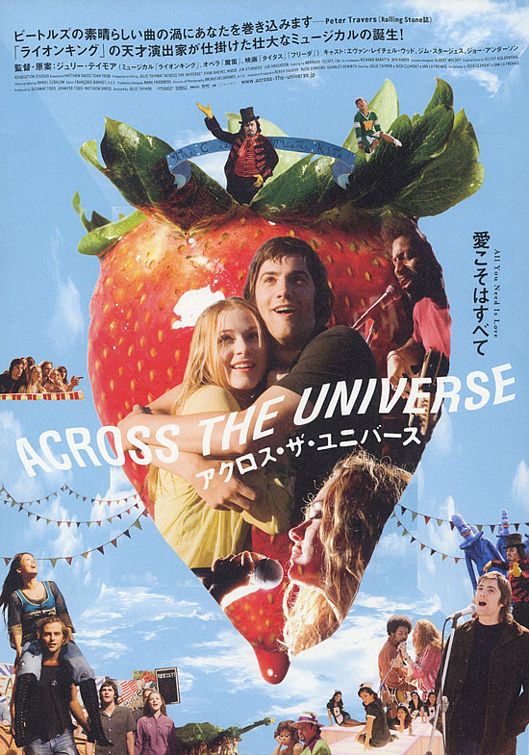
Moulin Rouge and Across the Universe

Poster for release in Japan.
The Recycled Musical may not be a term you’re familiar with; nor is it an official subgenre anyway, at least not for the academics.  For us, the Recycled Musical is a film or play that pulls popular music pieces from the culture and attempts to create some sort of narrative to unify them into a cohesive whole.  While Singing in the Rain is a classic film, few of the songs featured were original songs; in fact the majority of the songs had been heard on the radio and even in other films long before the film was made.

Moulin Rouge and Across the Universe both use popular songs to tell their stories, though in different ways.  Across the Universe set out to connect the songs, using them as a base and then filling in the gaps.  Moulin Rouge, however, uses the music we’re familiar with in order to borrow their meaning:  the film finds and uses music that will best deliver its point (the characters feel the way you feel when you hear THIS).
 
The idea, though, is that the Recycled Musical takes the stuff that we know, and may have used up already, and uses it to create something new.  While the product isn’t always better, the effort is almost always interesting.

KATE SAYS that Across the Universe is a blast! And I've realized that Beatles songs are surprisingly narrative (possibly one reason they have lasted so well and so long). The beginning of the movie feels very natural; the music might have been designed solely for the movie's plot!

The end of the movie feels a little more forced—the plot is twisted to fit the music rather than the other way around. Still, the overall effect is of a beautiful, natural love story.

In many ways, the milieu is the same as in Rent; however, this is the non-irritating version. For one thing, well, there’s the music! (Beatles versus, uh, everybody-else.) For another, events and people are fully complex. Nothing is easy or stream-lined. There are no good or bad people, not even in the scene at the draft office. And the focus is on the people, not on their message. One of the most touching parts of the movie for me is when Lucy is caught in the riot at the university. Terrified, she hunches in the telephone booth, whispering Jude’s words, “It’s gonna be all right.”

In fact, the entire movie reminds me of Poirot’s comment at the end of One Two Buckle My Shoe. After the villain gives his “ends justify the means” speech, Poirot replies, “Poirot is not concerned with nations. Poirot is only concerned with private individuals who have the right not to have taken from them their lives.”

Likewise, this movie is not about THE CAUSE and how one must be part of THE CAUSE in order to be SAVED. It is about people in love. Which is downright refreshing. Though the--deliberate?--irony of both movies is that what lasts is not love but art about love. (I don't suppose a bunch of writers, musicians, and choreographers could really come to any other conclusion.)

Moreover, Across the Universe is a real musical. It’s fascinating—to quote the Vulcan—to see how it pays tribute to movies we watched much earlier in this list. The choreography, such as the dance in the draft office, is far more reminiscent of Singing in the Rain than just about anything we’ve watched so far. And for a bigger-than-life payoff, Across the Universe totally delivers!

Across the Universe was an entirely new experience for me (though I own the DVD thanks to Mike). I had seen Moulin Rouge many years before. It wasn’t substantially different than I remembered (though in part that’s because I’m familiar with Buz Luhrmann’s work, including Strictly Ballroom). Moulin Rouge with its pastiches, tributes, borrowings, over-the-top numbers does a better job than Across the Universe at creating a polished product that is not completely run by its musical numbers (mostly because Moulin Rouge IS the musical numbers), yet the feel of both movies is quite similar. There’s that joie de vivre that seems to be rooted, again, in far older musicals, creating a direct link from Sound of Music (literally) to Rocky Horror to these films.

The one thing I had forgotten about Moulin Rouge—or not fully appreciated the first time—is what a powerhouse performer Ewan McGregor is. Because I got to know Ewan in non-singing parts, I always kind of assumed his voice in Moulin was dubbed. But that’s him, and, boy, wow, he is amazing.

I’m beginning to realize that I prefer those actors/singer, like Tim Curry, who really aren’t know for singing, yet have impressively distinct voices.

MIKE SAYS my first viewing of Moulin Rouge was.... let's say, not traditional.  While most saw this movie with a girlfriend or boyfriend, I had the pleasure of watching it with a fellow film geek... and before you ask, yes, it was awkward.  Luckily, the film was good.  Really Good.

Good enough that I showed it to my wife, and it became a favorite.  I've always had a soft spot for musicals and great visuals, and this film fulfilled both.  What I love most about the film is the music, but it's because of how and why it is used that I love it.  Of course, the fact that Ewen McGregor's voice rocks the house just helps the cause.

What I love about the music is that the referential nature of the music actually serves a purpose.  When McGregor sings "The Hills are Alive," the film isn't suggesting that he wrote or created the song.  Rather, it's using a very familiar and renowned song to communicate to the audience the power of his writing; his music is as powerful to the other characters as the song is to us.

It's the same with almost every other song.  The medley of love songs is my favorite from the entire film, as it works as an homage to love songs themselves, not just as a way to communicate what the characters are feeling.  The only possible exception here is "Like a Virgin," which feels a little shoehorned in for me.

The emotion and story of the film are powerful, and the performances of the cast are excellent.  There are a couple holes, but overall the film is rather amazing.  While I have seen a few films since then that tried to recapture the same magic, none have come as close as Across the Universe.

Rather than try to borrow the meaning of the songs given, the film uses them to give them meaning and context.  This works, for the most part.  But some songs, such as "Mr. K" are odd no matter the context.  My favorites of the bunch are "Dear Prudence" and "A Little Help from my Friends."  The movie actually illustrates these songs so well that they exist in my mind as the new definition.

If the films loses me at all, it's during the drug-induced montage during the gangs weekend traveling.  I get that its a sixties film, and I get that many Beatles songs were about drugs (or only made sense while on them).  However, I may never get over the weird grey Asian ladies dancing in the water.

I enjoy both movies very much, but if there is one things I had to complain about, it would be the same for both: I feel that the love stories were a tad forced.  While their relationships define the rest of both stories, the beginning of both relationships are sort of skimmed over.  We need them to be together, there's an attraction, let's do it.

While Moulin Rouge shows a little more of a courtship, this isn't much consolation, as said courtship takes only a few hours, and the characters are professing love within moments.  I get this on a writing level, but as a human being, I don't build relationships that easily.  I've had to work for almost every relationship I ever had, and lost many more because of my inability to do it properly.  I understand that the films are essentially about the outcome of the relationships . . . but yikes, can't we spend a little more time on how they start?

I really dug the idea of the "Recycled" musical for the list, because most people see musicals as being only original music.  At first thought, borrowing the music from someone else may seem like an easy way to write a film.  But I think it takes skill to work them into the story in such a way that feels natural.  For the most part, both films succeed more than they could have hoped.

But in future films, I would like a little less disturbing imagery with the music I love, ok? Thanks.


Wednesday, March 27, 2013

Beauty & the Beast and The Little Mermaid

Disney's First Full-Length Animated Film
Disney animated musical classics can be split into two eras: the first films, such as Snow White, Cinderella, and Sleeping Beauty. And the era of Menken and Ashman, who wrote the scores and lyrics for The Little Mermaid, Beauty & the Beast, and Aladdin. Like Rodgers & Hammerstein forty years earlier, together Menken and Ashman produced truly memorable music.

MIKE SAYS the most difficult thing about growing up during the Disney Renaissance was experiencing it  after everyone else. While my friends were all raving about The Little Mermaid, especially the girls, my family didn't get to see it until it hit video.  Thankfully, Mermaid was so successful that Disney decided to release it on video far sooner than their usual practice . . . a mere 8 months after it left the theaters.

Our trend of seeing the newest Disney film only on video continued for years . . . so long, in fact, that the next major Disney film I would see in the theater was A Bug's Life, which, incidentally, I saw with Kate.

Despite this time lag in my cultural education, the music of films such as Mermaid, Beauty and the Beast, Aladdin, and The Lion King was the soundtrack of my teens.  While I was far too awkward to try it in High School, there was the occasional mission companion that was romanced by my rendition of "Kiss the Girl" (and by romanced, I mean annoyed and repelled), and many a child brought to giggles by my enthusiastic recital of "Part of Your World," especially the line "Wouldn't you think I'm the girl, the girl who has everything?" which I belted out proudly, regardless of any gender conflicts.

Despite the magnificence of the Beauty soundtrack, the songs are a bit less singable for me.  This may have something to do with the complexity of the songs, which is far more impressive than that of Mermaid's . . . though it's probably due to the fact that I didn't get as strong a reaction when I sung them.

Despite the joys that come from singing Disney in public, the films themselves are very good, though much of their quality is due to the music itself.

Mermaid began the Disney Renaissance and, through music and animation, showed us that animated movies could be just as entertaining for the whole family.  Sure, these-cleaned up fairy tales may be full of stereotypes and gender roles, and all manner of other insulting things.  But every kid knows the frustration of experiencing things that parents have forbidden, and the embarrassment of discovering that your parents were right.

Beauty and the Beast especially resonates for me on several levels, and not always on the levels you might expect.  I understand Belle's search for a person who is deep and thoughtful, for someone who sees the world the way she does.  I also understand the Beast's fears that no one will ever see through the guise he wears in order to nurture and care for the person he can be.

While many different lessons, both good and bad, can be extrapolated from these retold fairy tales, kids almost always see the good, which is wonderful.  It's sad to think that it's we adults that have to over think things (for a great example of this, see my review on Bill and Ted's Excellent Adventure).

For me, an animated movie doesn't have to have musical numbers.  But at the same time, when we were considering movies for this list, these films didn't really occur to me.  I didn't always think of them as musicals.  But, when listening to the music and watching the numbers, you see that the scenes are the same as that of a stage musical:  people dancing in the streets, characters doing wild and crazy things, music from nowhere, everyone knowing the words . . .

The greatest thing about these films is their resistance to aging. My kids love these films, and they don't blink an eye at the animation; because it stands up.  And, these films, despite any subliminal messages, have good themes overall, which make it all the easier to encourage the kids to enjoy them.

But, to avoid some emotional scarring, I may not encourage my boys to sing the songs... at least not in public.


KATE SAYS my opinion of Disney's The Little Mermaid is influenced by two things. First, I consider any re-imagined version of The Little Mermaid to be better than the original.

Disney himself was influenced by
illustrators who emphasized
the darker side of fairy tales.
Grimm versions of fairytales can be incredibly violent--decapitation, anyone?--but Hans Christian Andersen's unique creations are utterly depressing. If ever a writer used the fairytale genre to work out his personal demons, it was this guy. People don't just die in Andersen's fairytales, they die alone, bereft, and unloved.

My second reaction is rooted in the mermaid as a symbol of spiritual castration, i.e. the mermaid's inability to walk can be equated to the mermaid's inability to act as a fully moral being. In lore, mermaids are often amoral and sociopathically detached.

I realize Disney is not operating from this standpoint, but I interpret Ariel's desire to walk not just as her desire for a rather limp romance but as her need for a fully integrated psyche.

Yeah, okay, that's way over-thought, but the idea is always there at the back of my head. Consequently, I react to the movie's plot holes (Ariel doesn't tell her dad where she is for three days--really? Ursula totally cheats at the end--what's so clever about that? Triton gives up his entire kingdom to an evil witch just because his daughter made a very bad bargain--what kind of king is he?) as balanced by the non-ambiguous nature of symbols: The Little Mermaid is an exploration of psychological development from dependence to independence (though I do wish Ariel showed a little more independence and hutzpah at the end).

The result is that the hero of The Little Mermaid is rather negligible. Believe it or not, Eric is slightly more interesting than Disney heroes prior to The Little Mermaid, who were little more than faces in suits, but he is still far less important than Ariel's rebellion and transition from non-speaking recklessness to speaking self-sacrifice. (I always think of Disney heroes pre-Beauty & the Beast when I read ridiculous commentary about the supposed chauvinism of fairy tales/Disney--sure, the women in Cinderella are all fighting over a prince, a MAN, but they are fighting over him for their own prestige and egos; his wants and needs are about as important as kelp.)

All said, I do consider the romance of Beauty & the Beast to be far more grown-up than that of The Little Mermaid. The dialog of B & B is downright sophisticated, not just lines like "If it's not Baroque, why fix it?" but also Belle and Beast's many exchanges, including Beast's grumpy, "But she is being so difficult!" followed by the very 'human' yell, "Then go ahead and *starve.*" 

This couple is not simply at the mercy of a sweet voice and a cute face (seriously, why does Eric want to marry a woman about whom he knows nothing? and why would Ariel want to marry a guy who is searching for Miss Perfect?).

In comparison, Belle and Beast are a couple that fights, argues, laughs, enjoys each other's company, protects each other . . .

Okay, I admit, I'm terribly partial to the "captivity narrative," in which the hero and heroine get to know each other without outside intrusions.

What's not to love about this guy?!
The one problem with Beauty & the Beast is the ending--not Gaston's fall into the ravine, which is par for the course in Disney's movies, but the appearance of the prince. It isn't just that he doesn't look anything like the adorable Beast, he doesn't act anything like him either. The grumpy, kind of geeky, slightly uncouth, and cheekily romantic Beast has been replaced by . . . Fabio.

If I were Belle, I'd sure be lodging a complaint right about this point.

Granted, the Beast's transformation is always a problem. Just as Belle has learned to love the Beast, so has the reader/viewer. McKinley, author of Beauty, rewrote her own masterpiece into Rose Daughter to try to fix this problem. But hey, Disney put the problem on film. When our family visited Disney Land shortly after the movie came out, the Beast was in the parade with Belle, NOT Fabio.

Whatever their plots, the music in both movies is perfect. Beauty & the Beast has a more purely musical stage quality; however, both provide bring-down-the-house numbers like "Be Our Guest" and the hilarious "Gaston" and, in The Little Mermaid, "Poor Unfortunate Souls," "Kiss the Girl," and the absolutely fantastic "Under the Sea." These songs are utterly memorable, utterly sing-along numbers. And the music really carries the plot; they are truly tributes to what it means to create a musical.

Wednesday, March 20, 2013

The Muppet Movie and The Muppets

The Muppet Show had been on the air four years when The Muppet Movie came out in 1979. It was followed by several movies about the Muppets (The Great Muppet Caper, The Muppets Take Manhattan) and several with the Muppets as literary characters (The Muppet Christmas Carol) not to mention three trillion television spin-offs (can anyone say, The Muppet Babies?).

KATE SAYS I admit I was nervous to see The Muppets (2011). I consider The Muppet Movie to be one of the most delightful movies on record with a perfect combination of memorable songs, an Americana plot, hilarious cameos, and raw feeling. Although the movie often breaks the fourth wall (as when Dr. Teeth et al. find Kermit and Fozzie in the desert by reading the script), it remains absolutely true to its own objectives.

But after The Muppet Movie, the Muppets got self-conscious. Although I enjoyed the second movie (mostly because of Charles Grodin: "Thieves aren't breathing down your neck!"), I disliked Muppets Take Manhattan after which I kind of gave up on the Muppets until The Muppet Christmas Carol. It seemed like every new rendition became more self-conscious and more cutisfied: kind of like Law & Order spin-offs: still okay, but not as gritty and heartfelt as the real thing.

So I was somewhat uneasy when I sat down to watch The Muppets.

I'll say this--it is still more self-conscious than I would have liked. However, it never pretends that it isn't exactly what it is: a tribute not just to the original Muppet Show but to the generation that was influenced and molded by that show. And at least three of the jokes/cameos sent me rolling to the floor:
(1) The 80's robot, especially when it starts up its modem, causing everyone in the car to wince. This is definitely a generational thing: I hate to say it, but I don't think even my (college) students would get that joke.

(2) The "Are you a Teenage Mutant Ninja Turtle?" line, especially the way Kermit pauses, then says, "Um, yes!"

(3) Jim Parsons. I won't say any more; I don't want to ruin it for anyone else! But I've never been so delighted.
I also happen to adore Chris Cooper who does a great job as the (fiction) guest celebrity. And I get a kick out of Jack Black who not only does a good job as the (real if reluctant) guest celebrity but captures the attitude/approach of many of the original guest celebrities on the show. I got a kick of Neil Patrick Harris's line ("Why am I not hosting this?"), the "evil English accent" line (kudos!) and this, possibly my favorite exchange (the WHOLE exchange):
Miss Piggy: Kermit. Jack Black has graciously agreed to do the telethon.
Kermit: That's amazing. Where is he?
Miss Piggy: In the truck.
Kermit the Frog: What? You kidnapped Jack Black? That's illegal!
Fozzie Bear: What's more illegal, Kermit: briefly inconveniencing Jack Black, or destroying the Muppets?
Kermit the Frog: Kidnapping Jack Black, Fozzie!
Miss Piggy: Kermit. Listen. Whatever I may think of you right now, these guys are counting on you. You inspired them.
Kermit the Frog: What, to kidnap people?
Miss Piggy: To work together.
Kermit the Frog: To kidnap people!?
Lew Zealand: Mr. the Frog, we all agreed, a celebrity is not a people.
I love Kermit's response to "you inspired them to work together": "To kidnap people?!" (And I love how kind Kermit is in both versions--with his little touch of acerbity.)

Extra kudos: like the first movie, the 2011 movie has a heart-felt theme which works on more than one level. It's a tad more slathered on than the theme of the first movie, but still within the same ball-park emotion and concept-wise. And I have to give credit to Jason Segal for playing his role (mostly) straight-faced although I think Walter wins here for never smirking (seriously!). 

All said and done, though, I still prefer the first. I love the music for one thing. I totally sang along during the movie. And few things in life are as touching to me as Gonzo's solo (see below). For another, I find I prefer those musicals that seem effortless--as if the actors and director just went out one day and created a film off the top of their heads. When Sweetums cried, "Hey, wait for me. C'mon guys, I want to go to Hollywood!" I was instantly reminded of a Rocky Horror exchange: Magenta's statement, "But I thought you liked them. They liked you" and Riff Raff's response, "They never liked me!"--all these lines come out of nowhere, yet totally fit their films.

The Muppets deserve a tribute, and The Muppets is a good movie; still, I mostly prefer them when they just were who they were without much self-reflection.

MIKE SAYS The Muppets helped define my childhood in more ways than I can ever fully express.  Sesame Street helped me love to learn, The Muppet Show helped me love to laugh, and The Muppet movies helped me love musicals.  The original Muppet movie was on throughout my childhood, and rarely a road trip went by without a stirring and glaringly off-key sing along of "Moving Right Along."

I don't find it odd at all that the Indie movie boom came along just about when those kids who first saw the Muppet movies in theaters became adults.  After all, if the Muppets can band together to make a movie, why not us?

The original movie stands up over the years, and my son loves it as much as I do.  The music is fantastic, the jokes are sharp, and the world of the Muppets is rich and warm.  To say that the new movie replaces the original movie in any way would just be blasphemy.  And, well, Untrue.

The Muppets is a wonderful and fitting tribute to the original, and to the age of the Muppets in general.  The number "Pictures in My Head" sums up the entire movie for me.  While I adore the entire soundtrack, this song in particular beckons to the memories and tells them that even though the time is passed, it's okay to relive them.  When I first saw the film in the theater, I was anxious, excited, and trying to prepare for a disaster.  Instead, when the Muppet paintings came alive during Kermit's song, I burst into tears. Because, as impossible as the thought was, I did want the Muppets to come back, and when they did, it was glorious.

There's a lot of great things about the new movie.  As I said, the music is absolutely wonderful, as is the message.  And despite some early controversy, I liked that the Muppets were able to stay funny without being compromised.  The Song "Man or a Muppet" is, I feel, the anthem of the Muppets generation.

But in the end, the movie is just what it feels like, a Tribute.  Maybe a return as well, but the truth is that any films that follow will never really reach the pinnacle of the original.  It's entirely possible that this is because of nostalgia, but I'd prefer to think it's because it was just a darn good film.


Tuesday, March 12, 2013

Chitty Chitty Bang Bang and Bedknobs and Broomsticks

This is the era of the live action family musical--with animation/special effects. Mary Poppins actually precedes these movies by four years. Willy Wonka came out the same year as Bedknobs. All these movies are based on children's books, and all star actors will extensive stage as well as screen experience.

It is entirely appropriate that the two movies being reviewed this week star the intrepid Dick Van Dyke and the once-a-lady-always-a-lady Angela Lansbury. Despite their differing nationalities, they have had remarkably similar careers. (They were even born the same year!) Angela Lansbury's career did begin at an earlier age (she appears alongside Elizabeth Taylor in National Velvet) but they both did most of their early, Tony-award-winning work on the stage. Dick Van Dyke then did a solid amount of work in television, including The Dick Van Dyke Show, before breaking into film with Bye, Bye Birdie although it was Mary Poppins that crystallized his fame. Both actors have wide-ranging abilities and have lent their famous voices to Disney. And both starred in their own, extremely popular mystery shows: Diagnosis Murder and Murder, She Wrote.

MIKE SAYS an advantage of growing up during the 80's, and the VHS boom, is that I got to grow up with many of the same films that my parents did; in a way that made them feel just as new to us during my childhood as those films did during theirs.

Chitty Chitty and Bedknobs were staples in my house, usually put in on a long dull Sunday to brighten things up; inevitably I always wound up falling asleep somewhere in the middle, and waking up again for the end.  Not that I didn't like the films, or watch them from beginning to end constantly, but really, who can stay awake for every viewing?

Chitty is probably the more complex film of the two, but I wouldn't say that makes it the better film.  It's complexity has everything to do with the structure: it's a story, then it's real, then a story, then real, then it's imaginary.  I've always found movies that are dream sequences to be somewhat annoying (you mean it never happened?!???!?!), and even as I kid I always found the reveal of the storytelling to be somewhat of a let down. While the flying at the end of the film redeems it somewhat, when viewed in context it just makes no sense!

Despite this, the film is fun, well-made (a tribute to the age of "epic" film making), and a lot of fun, even after all these years.  Chitty, the car, while not too impressive by today's standards, is still a cool gadget, and has a lot of fun surprises. The music is memorable for the most part, and the musical/dance sequences themselves many times make the music all the better.

The main attraction, though, is Dick Van Dyke.  He's warm, gentle, clever and funny, can dance and mime like a madman, yet sing so gently that I want to drift off to sleep.  Dick Van Dyke has a special place in my heart, not just for his roles in a few of my favorite childhood films; he also reminds me very strongly of my Papa (my mother's father).  None of my siblings agree with that, but for me, it makes the film all that more enjoyable. My favorite sequence of the film is "Music Box." The music is simple but charming, and Van Dyke's performance as the puppet (while admittedly aided by wires) is awe inspiring.

Bedknobs and Broomsticks is also extremely fun and clever, though it has the unfortunate role of being the follow up to Mary Poppins, one of the greatest musicals of all time. Bedknobs is good, great even in parts, but will never be seen as the equal to it predecessor, which is very sad, for when taken on its own, the film is a definite classic.

As a kid, my favorite element was the magic and mythology.  That the film had a rich backstory made it all the more fascinating to me.  Finding the lost isle with the magic creatures was almost always enough to get my little geeky heart pounding.

Angela Lansbury's performance is graceful, witty and enjoyable.  Having grown up with her as somewhat of a grandmotherly figure, though, I'm always somewhat flustered by the romantic sub-plot (as when I was young).  David Tomlinson, returning from Mary Poppins, is a constant source of laughs in the film, and delivers a solid, though less complex performance.

It seems that you can't have a 60's musical without some children, and the kids from both films are fairly impressive, though I will always consider the kids of Chitty Chitty to be among the sweetest.

I do love these films, and I hope to share them with my kids someday, though, if my wife has it her way, they'll be used to gain a little free time after the kids fall asleep watching them!

KATE SAYS this is the era of shaggy-dog film extravaganzas. Both Bedknobs and Chitty Chitty contain fairly simply stories with fantastical elements that seem intrinsic to British storytelling (consider Gilliam's whimsical visions).

Both films set the stage with little fanfare. Bedknobs has those impressive opening credits alongside a medieval tapestry and Chitty Chitty has the hilarious and rather odd (it has absolutely nothing to do with the rest of the movie) sequence of early car races. (Actually, there is a relevant point here about human ingenuity: the moment humans can do something--even if logically, they would be more sensible to wait until it was easier to do--they do it, like hold car races. The moment Hollywood figured out it could film in exotic locations, real and imaginary, it did so, even though filming in exotic locations is far easier today than it was then.)

Both films have strong characters, entertaining action sequences, and perfect pay-offs. Both films also contain long, rambling middle sections. In the case of Bedknobs, the middle of the movie is packed with at  least four numbers, including the memorable but lengthy "Portobello Road." In general, I prefer watching Miss Price interact with the children and Emelius Brown (played by the adorable Mary Poppins-father David Tomlinson).

In Chitty Chitty, the middle of the movie is taken up with the father's story. Parts of the story are very amusing (the car-as-floating-device and the hilarious spies--"We'll act like British gentleman!"). However, I've never been a fan of child-rebels, who remind me too much of Ewoks (of course, since the dad is making up the story to entertain his kids, it doesn't have to make sense). I far prefer the "courtship" between Caractacus Potts and Truly Scrumptious that takes up the rest of the movie.

In any case, I now see both films more as showcases for Angela Lansbury and Dick Van Dyke than as examples of tight story-telling.

Angela Lansbury is like Julie Andrews: a pure lady no matter what the character. (To be honest, Miss Price is really just Jessica Fletcher with a different back-story.)

This was my first time seeing Chitty Chitty Bang Bang, and I thoroughly enjoyed it. I was particularly impressed by Dick Van Dyke's serious side. In many films and shows, he plays up his goofy side. In Chitty Chitty Bang Bang, he exhibits a gentle thoughtfulness as the film's well-meaning and loving father (with great comedic timing). He and Sally Anne Howes have great rapport. And his character has the most adorable, non-irritating children in film history.

Which isn't to say that Chitty Chitty Bang Bang isn't a chance for Van Dyke to demonstrate all his talents. Nowadays if someone like Hugh Laurie can play piano as well as act, everyone is extremely impressed (shoot, I am!). Yet actors like Dick Van Dyke and Angela Lansbury could act, sing, dance, etc. etc. etc. and it was totally taken for granted. Consequently, they make it all look so effortless. Perhaps this is why the rambling middle sections don't irritate me as much as they do with other musicals. Watching these films is rather like playing shuffleboard or a long game of rummy: here's Dick Van Dyke and Angela Lansbury are here to entertain us, isn't that nice?  

Monday, March 4, 2013

The Rock Musical: Rent and Rocky Horror Picture Show

One of Rocky Horror's many pastiches.
The rock musical began more or less with Hair. The Rocky Horror Picture Show (the film) came along in 1975 and gained a cult following. Attendees are expected to participate by dressing up, throwing popcorn etc. (the DVD provides subtitles for participation at home). Rent (the film) came along in 1996.

KATE SAYS since I pretty much tear into the philosophy behind Rent on my blog, I decided (in the interest of tone and space) to restrict my comments here to the musical as craft rather than the musical as message.

Rent provides a tolerable viewing experience, and it gave me a great deal of insight into Spike’s song in the Buffy musical (more on this much, much later). The problem is never really paid off, but I was actually grateful for this since it allowed Benny to remain himself.

The film is watchable. It flows well. The cinematography is strong enough to keep the viewer’s attention although in general Chris Columbus’s direction is fairly pedestrian. The music, images, and occasional dialog mesh. And the actors are obviously talented (who knew Jesse L. Martin could sing?!).

I would be interested in watching the Live performance, only because although the film is effectively filmed, I didn’t find it particularly memorable. I quite like the main theme song, “Seasons of Love” plus “One Song Glory” and “I Should Tell You.” Otherwise, the film’s overall energy struck me as rather . . . eh. I’m not sure if this is due to the musical itself or to Columbus’s direction.

In contrast, although seriously disturbing, The Rocky Horror Picture Show is a far more energetic wild-ride of pastiches and unself-conscious counter-culture. Theme-wise, it is also substantially more honest than Rent (and much less lecture-y). Tim Curry does indeed deliver the role that made him famous (and for powerhouse singing, check out "I'm Going Home"). And well gosh darn it, Meatloaf shows up! Which is really all one could ask for.

Charles Gray as the narrator—that’s icing on the cake.

As precursors to current rock operas like Repo! The Genetic Opera, The Rocky Horror Picture Show is a far better indicator than Rent. I find Repo!’s music completely intolerable (except for the hauntingly beautiful “I Didn’t Know I Loved You So Much” and Shilo’s finale: “Genetic Emancipation” ), but that over-the-top-chewing-the-scenery-we‘re-just-telling-a-really-weird-story-for-its-own-sake feel is closer between Repo! and Rocky Horror than between the former two and Rent.

I quite honestly find it hard to understand why Rent won so many awards—okay, maybe not: I’ve watched the Tonys and they are sillier than the Oscars. But I can’t really recommend it as art; it’s more like commentary. Whatever The Rocky Horror Picture Show is attempting to do, it is art.

I mean, shoot, who can fault a musical where a main character says, without any wink-wink-nudge-nudge (even though the wink-wink-nudge-nudge is there), "Didn't we pass a castle back down the road a few miles? Maybe they have a phone."

MIKE SAYS one of the great things about this blog is that often it gives me a reason to watch something I really should have already seen.  Given Rocky Horror's cult status, its age, its cast, its history, and its genre . . . I really should have watched this ages ago.  My having not seen this movie before is like meeting a 12-year-old that can't tie his own shoelaces.  Sure, it happens, but most people roll their eyes when they find out about it.

Watching The Rocky Horror Picture Show is an experience I will keep with me the rest of my life.  It's not often that I sit down to watch a movie, only to be caught off guard by every single scene change, every plot twist.  I had no idea where the film was headed, nor did I have any idea of just how far it was willing to go.  The film is disturbing, ridiculous, and completely brilliant.

Rent, on the other hand, was an experience that I'll probably strain to remember next week.  While the music is catchy and fun, the movie is an emotional social drama that often skips action and plot for a chance to lecture and preach. There were some things I did enjoy about it; however the film got so distracted by the human drama and what it revealed about society, that the story got kind of lost.

The rock musical (I wonder what the difference is between rock musical and rock opera?) could really do no better for its poster child than Rocky Horror. The soundtrack is classic style rock with nods to favorites and classics along the way.  But the whole mood of the flick screams rock. From the corny Transylvanian accents, to the leather outfits and decayed corpses, Rocky Horror is stylistically exactly what you might expect, and hope for, from a rock musical.

Rent, on the other hand, is Rock in music only, and even then probably only because of an electric guitar and a couple drums.  The spirit of Rent is more a 90's alternative girl band. It may sound hardcore, but in the end, well, Rent just wants to whine about stuff.

Rocky Horror, however, doesn't have a single whiny bone in its body; the film is unapologetically and unabashedly what it is.  The film demands to be taken as what it is, and refuses to back off or try to make you feel bad about it.  While it is, undoubtedly, the strangest film I have ever seen, at the same time I really enjoyed it, because the film doesn't try to justify or explain itself.  It just IS.  Which, really, is what Rock is about.

Rent, on the other hand, is really just a dressed-up lecture.  While some of the issues it explores are definitely worth the time, the film never really comes to any firm resolution about it.  In fact, the plot for which the film is named gets dropped almost completely by the halfway mark.  While Rent doesn't pull any punches either, its motivation is tainted.  Rocky Horror has fun being what it is; Rent tries to entertain you while making a point (which is never really clear).

These films actually ended up creating a nice sort of counter-balance.  Rocky Horror is a Rock Musical both in form and theme, whereas Rent, despite pursuing topics that were not traditionally socially acceptable,  is really a Rock musical in form only.  Rent tries, but a bunch of grungy hipsters will never be more Rock & Roll than a man in full leather drag . . . though, thankfully, not as disturbing either.

Sunday, February 24, 2013

Streisand Sings!

Barbra Streisand's CV includes Funny Girl, Hello Dolly!, Funny Lady, Yentl, and of course scores of singing engagements. Like Bette Davis she combines a bigger-than-life stage persona with unusual looks (Davis is a better actor; Streisand is more of a performer). She tends to play the ugly-duckling-who-becomes-a-swan part quite often--including in the non-musical and highly entertaining Mirror Has Two Faces--which is almost entirely disconcerting since her personality tends to knock people flat before they notice her looks.

MIKE SAYS this film made me angry, very very angry.  Because somehow I got into my thirties without learning one very important movie fact: Barbara Streisand is AMAZING.

When the film started, I was nearly gave up within the first ten minutes.  But when the first musical number started, I began to laugh, and I kept laughing for most of the film. Streisand is hilarious, and thoroughly enjoyable. Her timing is fantastic; her singing and performance are nearly perfect. I was completely bowled over by her comedic skills, regardless of the movie's title.

The musical numbers of the film are fun and well done, though packed into clusters, and as such, the long periods between the numbers are a bit slow.

My only real issue with the film was the disturbingly calm and charming portrayal of Nick by Omar Sharif. Because of the age of the film ( Late sixties) the film uses some cuts, shots and pans that have long since been abandoned by traditional film. These shot are now used for horror films and abstract film-making to create a sense of foreboding and danger. Unfortunately, the majority of these shots are used for Nick, which prevented me from ever trusting him.

I spent the first half of the film terrified that it would take a twist, and the rest of the film would be about a woman recovering from rape.  While this may seem a bit extreme, I couldn't get past this small translation error in the film's language.  Another small confusion was the time setting of the film; despite some very expensive and colorful sets that were typical of classic musicals, the few flashes of location shooting clashed with the sets so strongly that the pallet of the film shifted from scene to scene. The film has just enough 70's graininess to it, that my brain couldn't ever quite nail down when exactly the film took place.

Despite this, I was impressed by the classiness of Nicks role, and his soft spoken manner and nature. Even though this hit me as creepy, it was still impressive to me that he never became a real threat to his wife and family.  The film preserved this small safe area, that everyone was safe, even though their hearts may be broken in the end.

Despite the quality of the acting and the musical numbers, the film's story and plot are a bit stretched, and the pacing is just plain inconsistent.  The movie is also quite long, and despite being fairly entertained, I felt every bit of that length, as did the various members of my family, who all slowly wandered out of the living room as they lost interest.

Funny Girl was a surprise, and I was completely shocked by how much I enjoyed it.  Not only that, but it finally clarified a very odd scene/reference from Mrs. Doubtfire that I never understood before seeing "Don't Rain on My Parade".  What a relief!

KATE SAYS I think Funny Girl is possibly the first musical I've ever seen where the dialog seems like a distraction from the numbers.

I'm usually all about the dialog/plot. I enjoy the musical numbers, especially if I can sing along, but I tend to treat the musical numbers as breaks in the story. Singin' in the Rain was unusual in this regard since plot and music were almost seamless.

They are not seamless in Funny Girl, and my reaction was that while the plot seemed to go on and on and on and not really lead anywhere, every time Streisand started to sing, the movie's energy level went up about two zillion degrees.

This is in big contrast to Hello Dolly! which is also an extremely long, rambling movie, but manages to stay in tune with Streisand throughout so that "The Parade Passes By" and "It Only Takes a Moment" are not that far apart emotionally.

But Funny Girl starts out full of energy (I love the scene after Fanny gets Ziegfeld's telegram and starts complaining that she hasn't suffered enough), massively drops off about 45 minutes in and then continues to drop even further. I like Omar Sharif and I thought his portrayal of a man who is, quite frankly, utterly out of his league with the ambitious Fanny to be totally believable. But I have no sympathy whatsoever for degenerate gamblers. My reaction to the ending was "Oh, well, yeah, that's no surprise" and then "I watched the whole movie for that?"

But of course, really, the point of the movie is Streisand as Fanny. Which I didn't mind. But it is 2+ hours, over an hour of which is watching people not sing while they slowly do and discuss things. From a very brief perusal, Funny Lady seems to use a similar format: exciting set pieces divided by a rather tepid plot (Funny Lady does include the marvelous Roddy McDowell).

Maybe I'm just a product of the Sesame Street generation except I grew up in a household without a television, and I can sit quite patiently through Shakespeare (even Coriolanus, which I saw with Branagh and Dench; I didn't understand it at all, but boy, it was British-actors-spitting fun!). I think really is comes down to my need for (1) more character development; (2) a narrative arc. Funny Girl is mostly a series of great, funny-to-the-point-of-splitting-your-sides bits with a rambling bunch of exposition smushed in between. 

If nothing else, this list is teaching me that the perfect musical may be harder to come by than even the perfect comedy or perfect drama! So many of the musicals so far have excelled in certain areas but the musical that has it all for all audiences--like The Sound of Music--is kind of the Holy Grail!

Wednesday, February 6, 2013

Oklahoma: The cast-of-thousands musical

In fact, Oklahoma! is a tad unusual when it comes to its cast of thousands; it was one of the first musicals to start with a solo rather than a big number: "Oh, What a Beautiful Morning" (and here's Gordon MacRae to make your bones melt).

However, the musical does produce a number of rousing, multi-person dance and song numbers.

Oklahoma! was the first Rodgers & Hammerstein musical and the first musical on this list that was made for stage before being transferred to film. It is being reviewed separately from next week's musicals (which will tackle more R&H plus Lerner & Loewe musicals). Starring Hugh Jackman and directed by Trevor Nunn, the 1998 revival of Oklahoma! was produced for London's National Theatre. Consequently, it is indicative more of the legacy of the stage musical than of the definitive Rodgers & Hammerstein/Lerner & Loewe approach.

MIKE SAYS Oy.  I'm not gonna lie; watching this film was torturous.  It was three, long, arduous hours of  musical numbers, painfully slow pacing, and an impressive set that was boring and well-known by the end of the play.

This was my first experience with Oklahoma!, I've never seen any of the other versions, though I am fairly familiar with the music.  In fact, for me, that may be more of a testament to a musical's impact than my personal enjoyment. Rather, the measure of success is to what level the musical numbers have permeated the our culture.  I may not give a hoot about Jud and all the other whooping and hollering folk in the play, but I've been known to sing a few bars of "Oh, What a Beautiful Morning" in the shower from time to time.

The power of musicals is impressive for this very reason.  I've never seen Oklahoma! before, nor did I end up really enjoying it a great deal, yet the music of the play is well known to me despite all this.  While the play may not have appealed to me personally, obviously it has impacted and influenced many people to the point that I've heard the music enough to know whole sections by heart.

I worked at a comic shop many years ago, and one of the things I loved was being around people that truly knew and understood the things I cared about.  More often than I would like to admit, a member of our group might start speaking a few opening lines to a song (often from a musical), only to have someone else respond, also speaking, with the next line, and this would continue until the whole shop had erupted into song and laughter.

Musicals, as a genre, bind people together in a way normal films don't; the music allows for people to share and relive moments that they enjoyed.

While I may not have enjoyed this play very much (and I may have nightmares from the disturbing portrayal of the farm hand), it was fun to hear the origin of music I've known my whole life.  If I was pushed, however, I suppose I could come up with at least one positive thing to say about the film: I did appreciate the quick resolution of the trial.  When the farm hand died, I rolled my eyes, expecting another 45 minutes or so of drama and crying song as the lovers were divided by jail.  It was nice to have a fast and happy resolution to the whole affair.  While Broadway isn't normally very forgiving, it was nice to see one of the exceptions . . . even if it was painful to sit through.

KATE SAYS unlike Singin' in the Rain, Oklahoma! was made for the stage; the numbers--more than the plot or the dialog--are the production's purpose. In fact, even by musical standards, Oklahoma!'s plot is about a teaspoon's worth of dialog to a barrel-full of music and dance. Unlike with Singin', there's a definite "now, it's time for a song" feeling; rather than move the plot forward, the songs instead comment on the action.

I quite like the Hugh Jackman/Trevor Nunn version, however, since even the songs are accompanied by subtle facial expressions and gestures that provide more information about the characters. Although "Pore Jud is Daid" is often played for laughs, Nunn's version carries a dark edge, mostly due to Shuler Hensley's disturbed portrayal of Jud and partly due to Hugh Jackman's interpretation of Curly. Curly is bewildered, disgusted, appalled, and frightened by Jud; his reactions go a long way towards explaining Laurey's terror.

In fact, this is one of the few versions of a 1940/50s musical where I don't mind the obligatory ballet number (Laurey's dream), partly because the sequence is so beautifully blocked and mostly because Nunn used the actual actors (in some versions, the dream Laurey, Curly, and Jud are different actors, who can dance ballet; Nunn used a far more stylized dance style which doesn't wear out the principal actors!).


I also prefer Nunn's image of Curly and Laurey. Gordon MacRae has a drip-like-honey stunning voice, but his Curly is so darn clean-cut and wholesome. Likewise, Shirley Jones looks like she just stepped out of Martha Stewart's magazine. In contrast, Hugh Jackman and Josefina Gabrielle come across as a  real, everyday, working-the-prairie couple, hardy enough to survive any changes that the new century will throw at them.

In fact, although Nunn's revival was later produced on Broadway, Jackman was replaced, and eh, I can't see it. The London revival is impressively dependent on the give and take between Jackman and Gabrielle: they give "People Will Say We're in Love" an adorable twist by teasing each other while also demonstrating friendliness and intense attraction.

So I greatly prefer the 1998 version to other, especially older, versions; still, I have to admit that Rodgers & Hammerstein probably did not anticipate the underlying sociopathic/Criminal Minds quality of Nunn's revival. Maybe that's why I like the 1998 version so much: I just love crime drama!

Sunday, January 27, 2013

Singin' in the Rain: And We're Off!

The film-musical's beginnings: Actually, the first full-length film musical was The Jazz Singer; this cultural phenomenon is referenced in Singin' in the Rain, and Singin' in the Rain is a tribute to The Jazz Singer era. It was released in 1952 but takes place in the "flapper" era when films changed from silent to "talkies." As it happens, most of the songs in the film had been featured in previous films, and each song was chosen and set before the script was even complete; as such, the screen writers faced the challenge of creating a story that would successfully tie the musical numbers together.

KATE SAYS when I lived with my sister Beth and her family in Washington, I must have seen this film at least a dozen times. Consequently, I assumed that this time around, my viewing would be rather cursory--you know, it's on in the background; I've seen it so many times, I just need my memory jogged . . .

But the moment the film started, I was captivated like always. What a fun film! What impressed me this time is that although Singin' is an old-fashioned film about an even older-fashioned era, the dialog comes across as fresh, contemporary, and very funny:
Don Lockwood: Now listen, R.F., the owner of the Coconut Grove may do what Lina tells him to, but you're the head of this studio.
R.F. Simpson: That's right, I'm the head of this studio. She's hired! But don't let Lina know she's on the lot.

Cosmo Brown: The new Don Lockwood. He yodels; he jumps around to music.

Girl in audience [about Lina]: She's so refined. I think I'll kill myself.
This time around, I especially admired Jean Hagen as Lina. She has some of the best lines in the picture:
Lina Lamont: Gee, this wig weighs a ton! What dope'd wear a thing like this?
Rosco: Everybody used to wear them, Lina.
Lina Lamont: Well, then everybody was a dope.

Rosco: Lina! We're missing every other word! You've got to talk into the mike!
Lina [pointing at the bush]: Well, I can't make love to a bush!
The wiring-for-sound scene is one of my absolute favorites.

I think a few of the numbers are unnecessary (be warned: I say this sort of thing a lot: love musicals; always think they are too long). I listened to part of the commentary, though, and realized that Gene Kelly, coming off An American in Paris, was considered THE movie's draw, so he got showcased a little more than the others. From the perspective of 50 years later, what impresses me is how seamlessly the story and characters and numbers work even when they aren't showcasing Gene Kelly. Since Gene Kelly directed, that's kudos to him. 

And I like how quickly the numbers go by (except for "Broadway Rhythm Ballet"--representative big number of the 1950s). They are blended without emphasis into the narrative: scene, singing, dancing, scene. And the dancing is vigorous. I admired ballet, but I like my dancing to have punch to it. Apparently Gene Kelly, primarily a dancer, made sure that dancing got its dues (there are remarkably few, if any, numbers in Singin' where people simply sing to the camera, which is more unusual than it sounds with early film-musicals).

Apparently, Baz Luhrmann also admires this movie--he's on the commentary! So there is already one connection to a later movie in our list. (I don't necessarily recommend the commentary on the special edition, however. The commentators, except for Luhrmann, seem to spend an inordinate amount of time commenting on how young Debbie Reynolds was/how woefully unprepared she was, blah, blah, blah . . . from the point of view of current viewers, her "unpreparedness" is what makes her so fresh! And she may have come to the film a non-dancer, but she effortlessly convinces me that Kathy Selden truly does deserve to be a star!)

MIKE SAYS it's funny to me that one of the most acclaimed musicals of all time would be, in fact, about musicals, Hollywood, and all of their quirks.  Singin' in the Rain cleverly pokes fun while paying homage to the film business.  Perhaps the most amazing thing is the fact that such a film is now over 50 years old.

I first saw the film while attending a film class in college, and it was one of the few films I was honestly grateful to be introduced to (sadly, I can't say the same for Citizen Kane . . . ugh).  What struck me is that the film's humor is as sharp for me today as it was when it was made, which I gather is not true for every viewer.  The one liners, snappy comebacks, and puns make me laugh nearly every time.

Perhaps the only thing I noticed upon this viewing was the casual and familiar way the songs were presented, almost as if the filmmakers expected the audience to already be familiar with them. It was this style of presentation that caused me to look into the history of the music, where I found that, as I suspected, each of the songs were popular favorites at the time.

This simple fact blows my mind.  While it doesn't diminish the film by any means, it  seems that this is something I really should have already known!

Despite this, or maybe because of it, the film really is a marvel, and is a wonderful example of the "epic" film making that just doesn't exist any more.  It's also a testament to a different age of film making, when the actors were required to be talented in a huge range of entertainment, requiring dance, singing, and even high energy acrobatics.  That this can all be done with what appears to be just genuine smiles (even when the actors were ill and injured, something that happened a great deal in the making of this film), just leaves me stunned.

The film is hugely enjoyable even today, with it's technicolor brightness, energetic dance numbers and catchy music.  The story, as cobbled together as it may be, is surprisingly cohesive and satisfying.  One thing I really enjoyed was that the romantic subplot was largely over by the middle of the film.  Instead of dragging out the drama, the film quickly establishes the relationship and moves it along at a believable level, and it saves the drama for when it would be the most powerful:  the end.

The rhythm of the film is also a thing of beauty.  It starts simply, and builds, with the musical numbers slowly building in scope and frequency, until finally exploding in the huge montage of the Broadway sequence.  The numbers then begin to thin out as the movie winds down.

The quality of the film is such that modern films really do seem like monuments of laziness and short cuts.  CGI seems like a sort of twisted blasphemy when compared to the titanic amount of talent and work put into Singin' in the Rain.  For some reason, this line of thought brings to mind an image of Gene Kelly punching Michael Bay, or even George Lucas, square in the face.  While there's nothing in the film, or history, to suggest such an outcome if they were to meet, the mental image makes me happy all the same.